Culinary Arts Colleges in Kolkata: Trends and How to Choose
Culinary arts colleges in Kolkata are gaining popularity as the hospitality industry expands across India. From hands-on kitchen training to industry-focused internships, students today are looking for culinary programs that combine creativity, practical exposure, and career opportunities. This guide explains how to evaluate culinary institutes, compare diploma options, and choose the right hospitality career path.
Executive Summary
Kolkata’s vibrant food culture and booming tourism are making culinary arts colleges in Kolkata a magnet for aspiring chefs. This article examines why culinary education in Kolkata matters—with industry growth driving demand—and breaks down what these programs involve. We analyze the latest trends (sustainability, tech, health), common challenges (skill gaps, quality issues), and compare program types (diploma vs degree). We also share expert advice (on faculty, accreditation, and hands-on training) and a step-by-step evaluation framework. By the end, you’ll have actionable criteria to select the best culinary course in Kolkata for your goals.
Why This Topic Matters
Kolkata is the cultural capital of West Bengal, known for iconic sweets, street food, and a blend of Indian and continental cuisine. In 2024, West Bengal welcomed about 3.1 million foreign tourists, the second-highest in India, reflecting strong demand for hospitality services. As tourism and corporate events surge, hotels and restaurants multiply—meaning more job openings for trained chefs. India’s hospitality market is projected to exceed $31 billion by 2029, underscoring lucrative growth prospects. For students, enrolling in a quality culinary arts course in Kolkata translates into real career opportunities. Understanding industry dynamics and how colleges differ is key to making a choice that leads to success.
Culinary Arts Education in Kolkata
Culinary arts programs teach the art and science of food preparation, combining cooking skills with management knowledge. In Kolkata, you’ll find a range of options: short certificates, professional diplomas, and full degrees. For example, Krystal School of Excellence offers a 12+6-month diploma in culinary arts (12 months of theory + 6 months of internship) that covers world cuisine, food safety, and kitchen economics. Diplomas (often 1-2 years) focus heavily on hands-on kitchen training and cost under ₹1 lakh in Kolkata. By contrast, a 3–4 year bachelor’s degree (e.g., BHM/B.Sc.) includes culinary science, hotel management, nutrition, and entrepreneurship. All good programs balance practical labs (cookery, baking) with theory (nutrition, service, etiquette). In sum, culinary arts courses range from basic skill upgrades to comprehensive hospitality diplomas/degrees. Each leads to different career tracks—a diploma often yields chef/line cook roles, while a degree may open managerial or international positions.
Important Industry Trends
Culinary education is evolving with global food trends:
- Sustainability & Local Sourcing: Programs now teach eco-friendly practices, like reducing waste and using local, seasonal ingredients.
- Plant-Based & Wellness: Many colleges include modules on vegetarian/vegan cooking and nutrition to meet health-focused dining trends.
- Digital & Virtual Learning: COVID accelerated online culinary classes; now virtual kitchen demos and online recipe platforms supplement in-person labs.
- Global Cuisine & Fusion: Curricula expose students to international flavors and fusion techniques, preparing graduates for diverse kitchens.
- Technology & AI: Chefs-in-training learn to use smart appliances, kitchen robots, and data-driven recipe tools as automation grows.
In short, the institutes in Kolkata's programs increasingly emphasize sustainability, health, and technology. For example, a course might offer special classes on plant-based desserts or virtual reality kitchen training. Choosing a college that stays current with these trends ensures your skills remain in demand.
Common Challenges in Culinary Education
Aspiring chefs must navigate several industry challenges:
- Skill Gap & Shortage: India faces a shortage of an estimated 150,000 trained hospitality workers. Many newcomers lack formal training—around 70% of hospitality employees are not professionally certified. This means some graduates still feel underprepared for a busy kitchen.
- Turnover: High attrition (40–45% annually in hotels) pressures institutes to produce job-ready chefs quickly. Programs must pack practical experience into short durations.
- Quality Variance: Kolkata has both renowned schools and fly-by-night institutes. Without strict oversight, some courses may not meet industry standards. Experts advise verifying accreditation: ensure the college is recognized by relevant bodies (NCHMCT, UGC, etc.). Unaccredited programs may offer certificates that employers don’t accept.
- Theory-Practice Gap: Some curricula remain too theoretical. Look for schools emphasizing lab work and internships. As one authority notes, top programs guarantee hands-on training, not just lectures.
Overall, the biggest risk is enrolling in a program that fails to build practical skills. We address this by focusing on questions about faculty, kitchens, and placement below.
Comparing Program Types
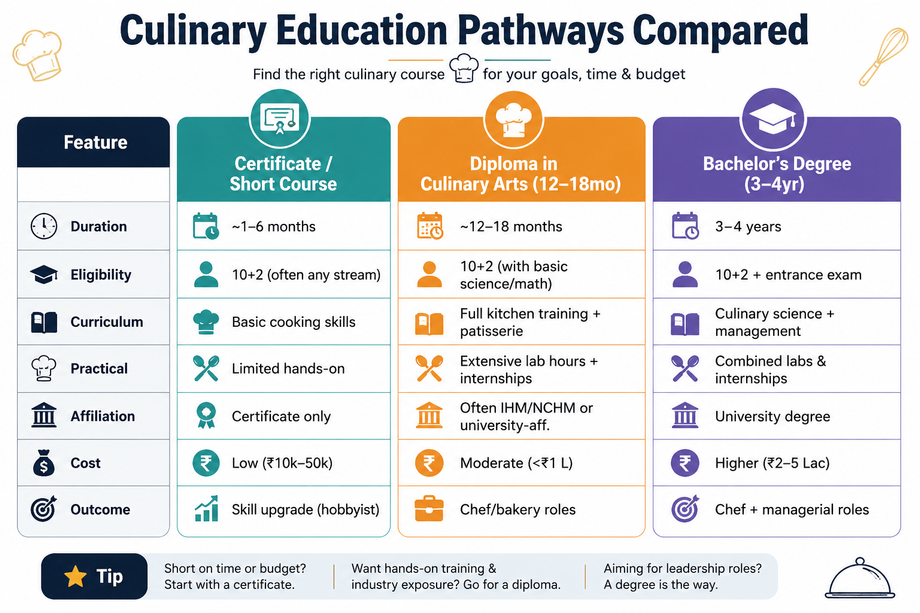
Kolkata’s culinary courses can be broadly grouped by credential:
- Certificates/Short Courses: Great for specific skills (e.g., a 3-month baking course). Affordable but limited scope.
- Diplomas: These are Kolkata’s most popular culinary arts diploma in Kolkata programs. They prioritize cooking, baking, and service skills. Diploma grads often start as chefs or sous-chefs.
- Degrees: More academic, incorporating hospitality management and general education. A degree can lead to supervisory roles or higher starting salaries.
Another key comparison is private vs. public institutions. Kolkata has many private culinary schools and only one main public IHM (Institute of Hotel Management) campus. For instance, IHM Kolkata’s B.Sc course accepts students via the national NCHMCT JEE exam. Private colleges (like Krystal School) set their own admission process and fees. Both types can be good: public institutes often have subsidized fees and standardized curricula, while private schools may offer specialized training (e.g., advanced pastry labs).
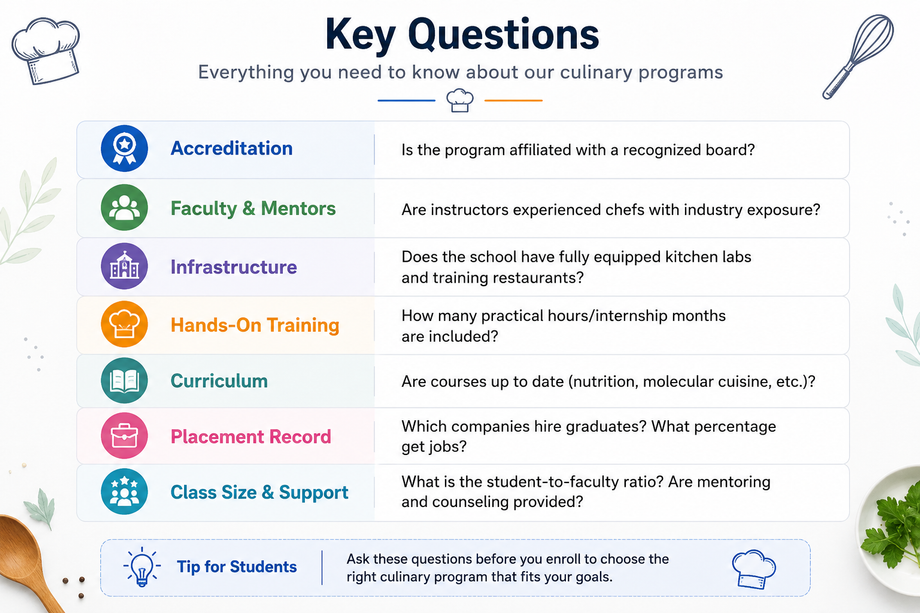
Strategic Framework: When choosing a specific college, consider the “5 Ps”:
- Professor (Faculty quality)—Are instructors experienced, chefs?
- Practical (Hands-on)—How many kitchen lab hours? Are internships guaranteed?
- Program (Curriculum)—Does the syllabus cover modern cuisine, management, and hygiene?
- Placement – what percentage of students get jobs, and which companies recruit?
- Price—Are the fees justified by the training quality?
Expert Insights
Hospitality educators emphasize these selection factors:
- Faculty Expertise: Seek colleges where chefs with industry experience teach classes. If instructors have worked at top hotels or overseas, students gain insider knowledge.
- Accreditation & Legacy: Prefer schools with national or international accreditation and at least a decade of history. Older institutes typically have refined their programs over time.
- Hands-On Training: Verify that the program offers substantial kitchen practice. The best culinary institutes run student-staffed restaurants and bakery labs and require industrial internships.
- Curriculum Breadth: Quality courses blend cooking with hospitality management, nutrition, marketing, and soft skills. For example, Krystal’s diploma covers food safety, budget control, and communication alongside cooking.
- Placement Record: Top schools often claim >90% placement. They have tie-ups with hotel groups (JW Marriott, Taj, Oberoi, etc.). When evaluating, ask for recent placement statistics and alumni testimonials.
These expert guidelines align with major reviews: any culinary arts college in Kolkata should excel on faculty quality, practical training, and strong industry connections.
How to Evaluate Culinary Colleges (Step-by-Step)
- Define Goals: Are you passionate about pastry arts, fine-dining cuisine, or hotel management? Clarify your career path (chef, baker, or restaurant manager) to guide your search.
- Compile Options: List colleges in Kolkata offering culinary courses (diplomas, degrees, etc.). Don’t rely on rank alone – include lesser-known institutes with strong reputations.
- Check Essentials: For each school, note accreditation, course duration, and fee. Ensure that any diploma or degree is recognized by India’s hospitality council or a university.
- Compare Curriculum: Look at syllabi. The program should cover core cookery skills (Indian and global cuisines), plus food safety, nutrition, and some management or entrepreneurship. Modern topics (sustainable cooking, digital tools) are a bonus.
- Assess Facilities: Visit or virtually tour campuses. Quality colleges have real commercial kitchens, baking labs, and dining facilities. A high student-to-kitchen ratio means more hands-on time.
- Meet Faculty/Students: Attend open houses if possible. Talk to current students and instructors about learning style and workload. Firsthand impressions often reveal fit better than brochures.
- Review Outcomes: Inquire about recent alumni placements. If hotels like Taj or ITC regularly hire grads, that signals strong training. Also, ask about salary figures; top culinary programs in India boast starting packages up to ₹10 LPA in premium hotels.
- Decide and Enroll: Weigh pros and cons (see table below). Consider location and costs, too. Once satisfied, follow the admission steps (note that some programs may require an interview or test).
Comparison Checklist
Actionable Recommendations
- Do a kitchen demo: If possible, sit in on a cooking demo or open-house workshop. You’ll experience teaching style and facilities firsthand.
- Ask Trend Questions: Inquire if the course covers modern themes (vegan menu creation, fusion cuisine, etc.). Colleges that mention [8†L60-L66] plant-based or health-focused classes are ahead of the curve.
- Check Dual Certifications: Some Kolkata diplomas (like Krystal’s) offer an additional international certification. This can boost your resume if you seek global opportunities.
- Compare Costs vs. Content: Don’t pick solely on low fees. Instead, compare what each rupee gets you—a state-of-the-art facility and internship opportunities often justify higher fees.
- Talk to Graduates: Reach out to alumni via LinkedIn or community forums. Ask what they liked and what could improve. Insider info can be very revealing.
- Use Official Rankings Carefully, Indian rankings (India Today, Outlook) focus on multidisciplinary HMs. A highly-ranked IHM may have a strong culinary stream, but many good institutes aren’t ranked nationally. Balance ranking with these practical factors.
Frequently Asked Questions (FAQ)
- What kinds of culinary courses are offered in Kolkata?
Institutes in Kolkata offer a spectrum: short-term certificates (3–6 months), one-year and 1.5-year diplomas; and full degrees (B.Sc./BA in culinary arts or hotel management). For example, Krystal School’s flagship program is a 1.5-year diploma in culinary arts. There are also specialized diplomas (e.g., patisserie, hotel management). Choose based on how deep you want to study: diplomas for rapid practical training, degrees for broader education. - How much do culinary courses cost in Kolkata?
Fees vary widely. Generally, diploma programs in Kolkata cost under ₹1 lakh total. Bachelor’s degrees (3–4 years) will be higher (a few lakhs). Short certificate courses can be as low as ₹10,000–50,000. Always check if fees cover materials, uniforms, and internship facilitation. Beware of hidden costs (some schools separate exam and kitchen fees). Compare value: a slightly higher fee might come with better facilities and career services. - What jobs can I get after a culinary arts course?
Graduates typically find roles as chefs (commis, chef de partie, and sous-chef) in hotels and restaurants. There are also positions like pastry chef, bakery manager, food stylist, or catering manager. Some join cruise ships or airlines as culinary staff. The FAQ from Krystal lists roles: commis baker, head baker, pastry chef, chef de partie, and even managerial roles. Top recruiters for Kolkata culinary grads include major hotel chains (Taj, Marriott, Hyatt, etc.). With experience, chefs can advance to executive chef or hotel F&B manager or even start their own venture. - How do I choose the best culinary institute in Kolkata?
Start by defining your priorities (e.g., bakery vs. savory, location, duration). Then assess potential schools on the factors above: accreditation, faculty expertise, hands-on training, and placement success. Narrow down by visiting campuses or talking to counselors. Remember, an institute that excels in one area (like pastry) might be weaker in another. Use a weighted checklist if needed. Ultimately, the best culinary institute is one whose training fits your career goals and learning style. Look at alumni: if graduates are employed at well-known restaurants or hotels, that’s a strong indicator of quality. - Are there national entrance exams for culinary programs?
For most private diplomas in Kolkata, admissions are often merit-based or interview-based. However, for government-run programs like IHM Kolkata’s B.Sc., entry requires clearing the national NCHMCT JEE exam. Some private groups may conduct their own aptitude tests or group discussions. Always check the specific college’s admission criteria—these are usually listed on their website or prospectus.
Conclusion
Choosing the right culinary arts program in Kolkata is a big decision, but a rewarding one. The city’s growing hospitality industry and rich food scene mean that well-trained chefs are in demand. By focusing on education quality—such as experienced chefs as faculty, up-to-date labs, and strong industry connections—you can narrow your options effectively.
For example, Krystal School of Excellence offers an 18-month Indian + UK-certified diploma with extensive practical training. While we have highlighted Krystal as an example of a culinary arts diploma in Kolkata, remember to compare multiple institutes: look for the best mix of theory and hands-on experience, and check reviews or rankings if available.
In the end, a great culinary education blends passion with rigor. Use the insights above to evaluate each school critically. With the right training, you’ll be prepared to craft delicious dishes and forge a successful career in Kolkata’s vibrant culinary world. For more information, visit Krystal School of Excellence at and explore their admissions options.


Comments
Post a Comment